
Quick answer: From 1 October 2026, a new UK tax called the Vaping Products Duty (VPD) adds £2.20 to every 10ml of vaping liquid sold in the UK — about £2.64 once VAT is included. It applies to all e-liquid, whether or not it contains nicotine. It does not apply to hardware — devices, coils, batteries, and empty carts stay at standard 20% VAT only. That single fact is the whole story for anyone using refillable kits or empty carts: your gear doesn’t get taxed, only the liquid you put in it does.
If you’ve bought a vape, a bottle of e-liquid, or an empty cartridge in the UK recently, you’ll already know the market has been through a lot of change lately. Disposables were banned in June 2025. Now there’s a new tax landing on the liquid itself. It’s confusing if you’re just trying to work out what you’ll actually be paying come autumn – so here’s a plain-English breakdown, using the actual HMRC figures, of what’s changing
The Vaping Products Duty is a new excise tax on vaping liquid, first announced by the government at Spring Budget 2024 and confirmed as part of the Tobacco and Vapes Act. It’s charged at a flat rate of £2.20 per 10ml of vaping liquid, working out at 22p per millilitre. Unlike an earlier proposal that would have taxed liquid differently depending on nicotine strength, the final version is a single flat rate that applies to every bottle — 0mg nicotine-free liquid included.
HMRC opened applications for businesses to register for the duty on 1 April 2026, and the tax itself takes effect on 1 October 2026. Alongside it, a Vaping Duty Stamps scheme is being introduced — similar to the stamps you already see on cigarette packets and spirit bottles — so that retail packaging can prove the duty has been paid.
| Date | What happens |
| 1 April 2026 | HMRC opens registration for manufacturers, importers and warehousekeepers |
| 1 October 2026 | Vaping Products Duty becomes payable; duty stamps start appearing on new stock |
| 31 March 2027 | Deadline to sell through any unstamped stock made or imported before October 2026 |
| 1 April 2027 | It becomes illegal to sell any vaping liquid without a duty stamp, no exceptions |
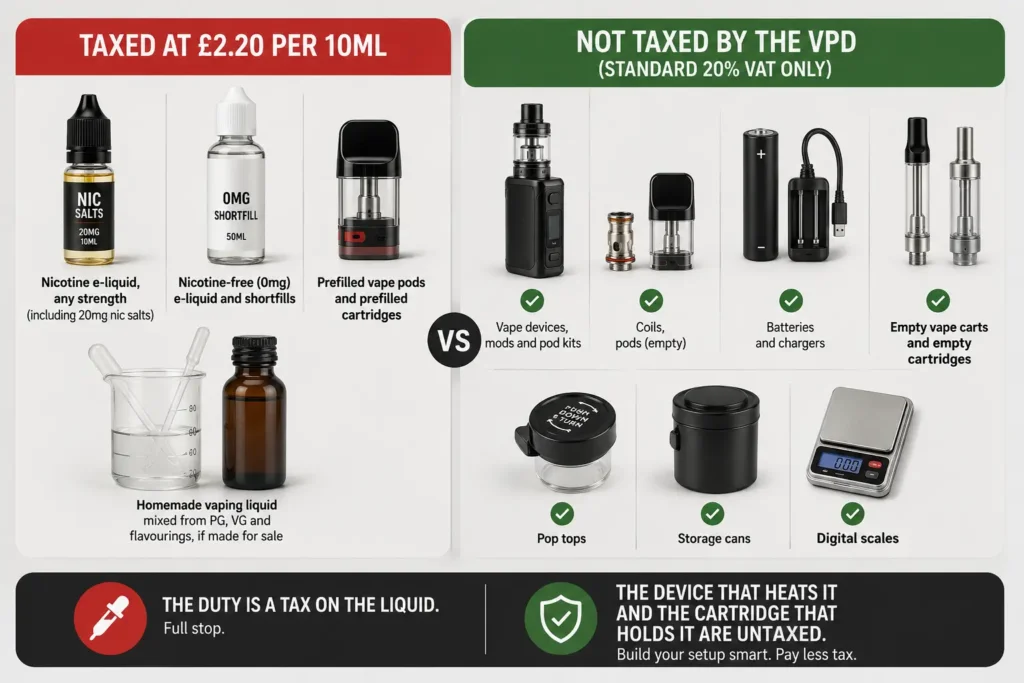
This is the part that matters most if you’re already using a refillable device or an empty cart setup, so it’s worth being precise about it.
Taxed at £2.20 per 10ml:
Not taxed by the VPD (standard 20% VAT only):
In other words, the duty is a tax on the liquid, full stop. The device that heats it and the cartridge that holds it are untouched. If your setup is built around empty carts, terpenes, and a liquidizer rather than pre-filled pods, the tax lands on a much smaller part of your total spend.
Here’s what the duty adds to common formats, before you factor in what retailers may add on top for VAT and their own margin:
| Format | Volume | Duty added | With 20% VAT |
| Standard nic salt bottle | 10ml | £2.20 | ~£2.64 |
| Shortfill | 50ml | £11.00 | ~£13.20 |
| Large shortfill | 100ml | £22.00 | ~£26.40 |
| Prefilled pod | 2ml | £0.44 | ~£0.53 |
Two things stand out here. First, shortfills take the biggest hit — a 100ml bottle that used to be a bulk-buy bargain now carries over £22 in duty alone, which can roughly double what a heavy shortfill user pays per bottle. Second, prefilled pods are comparatively the least affected in cash terms, simply because there’s so little liquid in each one — though people using several pods a day will still feel it add up over a month.
Hardware pricing isn’t expected to move because of the duty itself, since VPD doesn’t apply to it. Any hardware price changes you see will be down to normal market factors, not this tax.
If you’re deciding between sticking with prefilled pods or building your own setup around a refillable device, empty carts, and your own liquid or terpene blend, the maths after October leans further in favour of refillable.
Prefilled pod route: every pod you buy has the duty baked into its shelf price. Buy pods every week, and you’re paying that 22p-per-ml charge over and over, on top of the manufacturer’s markup for pre-filling and packaging each pod individually.
Refillable / empty cart route: the cartridge or tank is a one-off, untaxed purchase. You then only pay the duty once, on the liquid or e-liquid base you refill it with — and buying liquid in bulk generally works out cheaper per ml than buying the same volume split across dozens of small prefilled pods, even with the new duty added.
The gap won’t be enormous for light users, but for anyone vaping daily, refilling your own hardware rather than replacing prefilled pods is likely to stay the more cost-effective habit — which was already true before the duty, and the duty structure doesn’t change that underlying logic.
This is a common question from people in the empty cart and reusable vape space, so it’s worth answering directly: the duty is defined around “vaping liquid” broadly — anything intended to be vaped, made from a base like PG, VG, or similar carrier liquids and flavourings — and it’s charged to the manufacturers, importers and warehousekeepers who bring that liquid to the UK market, not to individuals filling their own cart at home for personal use.
Practically, that means:
If you run a business that manufactures or imports vaping liquid for sale in the UK, the compliance side is far more involved — you’ll need to register with HMRC, apply for duty stamp approval, and build the duty into your pricing well ahead of October. That’s a separate, business-facing process, and if that applies to you, the official HMRC guidance is the right place to check your obligations rather than relying on any blog, including this one.
Yes, by a wide margin. Alongside the vaping duty, the government is also raising tobacco duty at the same time — reported at roughly £2.20 per 100 cigarettes — specifically so that vaping doesn’t lose its cost advantage over smoking. For most regular vapers on a refillable setup, vaping is still expected to work out several times cheaper than smoking, even after October’s changes.
When does the UK vape tax start? The Vaping Products Duty takes effect on 1 October 2026. It doesn’t apply retroactively to stock made or imported before that date, which can still legally be sold, unstamped, until 31 March 2027.
How much is the new vape tax? £2.20 per 10ml of vaping liquid, which works out to roughly £2.64 once standard 20% VAT is added. This is a flat rate — it applies the same way whether the liquid contains nicotine or not.
Does the vape tax apply to nicotine-free e-liquid? Yes. The duty is charged per ml of liquid, not per mg of nicotine, so 0mg shortfills and nic-free liquids are taxed at exactly the same rate as nicotine-containing ones.
Are vape devices, coils, or empty carts taxed? No. The Vaping Products Duty applies only to the liquid. Devices, coils, pods, batteries, and empty vape carts remain subject to standard VAT only, with no additional duty.
Will refillable vapes be cheaper than prefilled pods after October 2026? Refillable setups are likely to stay the more cost-effective option, since the duty is charged once per ml of liquid regardless of format, and buying liquid in bulk to refill your own hardware typically costs less per ml than buying it pre-packaged into individual pods.
What are Vaping Duty Stamps? Physical stamps on retail packaging that prove the duty has been paid, similar to the stamps already used on tobacco and spirits. They start appearing on new stock from October 2026, and become mandatory on all vaping liquid sold in the UK from 1 April 2027.